
In short
- Springs above the opening or beside the overhead tracks counterbalance the door's weight, while lift cables carry that force to its bottom corners.
- Rollers travel inside the tracks, and hinges join the horizontal sections so the door bends as it opens.
- The opener moves the balanced door, while photo eyes near the floor detect an obstruction across the opening.
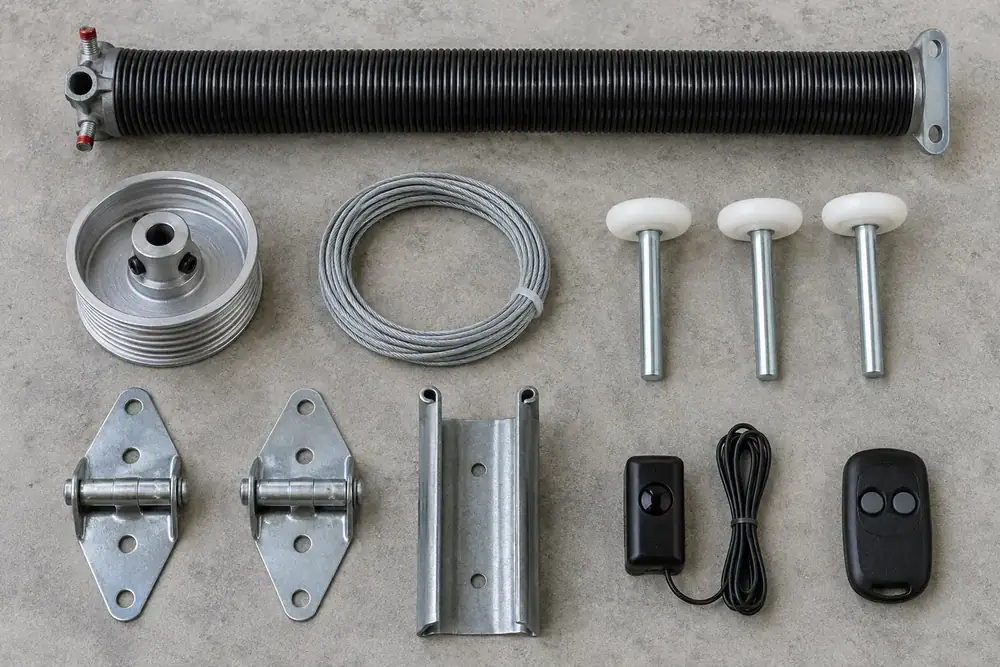
Spring Hardware, Door Sections and Opener Controls
The springs, moving door hardware and opener controls work together, but a failure in one group can look like trouble in another. A humming opener does not prove the motor is broken: a failed spring can leave the door too heavy to move. Call with the symptom you notice; identifying every component is unnecessary.
The Spring and Cable Assembly
The torsion spring is the tightly wound coil on the bar above the opening; extension springs stretch beside the overhead tracks. Both types counterbalance the door. A snapped spring may make a loud bang, leave a visible break or make the door suddenly feel heavy. Your technician replaces the failed spring with one matched to the door's weight.
The winding cones are the fittings at the ends of torsion springs. The torsion bar is the shaft carrying the spring assembly, and drums are the grooved wheels near its ends. Clopay's residential torsion spring manual identifies these connected components and warns about dangerous spring tension. Shifted hardware, loose cable loops or a tilted door call for a technician's inspection; do not tighten, loosen or reposition anything in that assembly.
Lift cables run down the sides to bottom brackets at the door's lowest corners. Fraying, slack or a cable hanging free means the lifting system needs attention. Clopay's parts guidance leaves spring and cable replacement to professionals. Keep clear and stop operating the door.
The Parts and Their Warning Signs
Each part below has a distinct job, and the warning signs help you describe the fault without handling the hardware.
| Part | What it does | Sign it is failing | Safe to touch? |
|---|---|---|---|
| Torsion or extension springs | Counterbalance the door above the opening or beside the tracks | Broken coil, bang or suddenly heavy door | No |
| Winding cones | Hold and adjust torsion spring tension at the spring ends | Shifted fitting or uneven lifting | No |
| Torsion bar | Carries the spring and drum assembly above the door | Visible bending or abnormal movement | No |
| Drums | Wind lift cables at the shaft ends | Cable loops outside the grooves | No |
| Lift cables | Transfer lifting force down both door edges | Frayed strands, slack or one side dropping | No |
| Bottom brackets | Anchor lift cables at the bottom corners | Pulling away from the section | No |
| Tracks | Guide rollers up the sides and overhead | Bent rail or rubbing door | No |
| Rollers | Carry the sections through the tracks | Wobbling wheel, scraping or wheel outside the rail | No |
| Hinges | Join sections and let them bend | Cracked hinge or separation at a joint | No |
| Sections | Form the horizontal door panels | Dent, split or buckling panel | No |
| Struts | Reinforce sections with horizontal metal bars | Bowed bar or flexing section | No |
| Bottom seal | Closes the gap along the floor | Torn strip or daylight underneath | No |
| Opener motor | Powers movement from its overhead housing | Humming without movement or repeated stopping | No |
| Drive | Transfers motor power through a chain, belt or screw | Grinding or movement without door travel | No |
| Trolley and release cord | Connect the opener rail to the door and disengage that connection | Drive moves while the door stays still | No on a faulty door |
| Photo eyes | Send a safety beam across the opening near the floor | Door refuses to close or sensor indicator changes | Lenses and alignment only |
| Wall control | Sends commands from beside the garage entrance | Remote disabled by its lock setting | Lock switch only |
| Remotes and keypad | Send opening commands from a handheld unit or outside keypad | Buttons work intermittently or fail to respond | Remote battery and controls only |
Tracks, Sections and the Bottom Seal
Rollers are the small wheels inside the tracks, and hinges let adjoining sections bend through the overhead curve. Clopay's component descriptions explain those jobs and the reinforcing role of struts. Worn wheels, damaged hinges or bent rails can produce shaking, scraping or a crooked door. Your technician checks the cause and replaces or realigns the affected hardware.
The bottom seal is the flexible strip beneath the lowest section. Tears leave gaps for drafts and debris. A damaged seal can be replaced, but rust or rot in the section above it needs a separate assessment. Leave the door and its attached hardware alone.
The Opener and Its Safety Controls
The opener motor usually hangs overhead; its drive moves a trolley, the sliding connector along the rail. Genie's maintenance explanation distinguishes the motor, drive and carriage connection. Grinding or a moving drive with a stationary door needs diagnosis. Do not pull the release cord beneath a raised, crooked or damaged door.
Photo eyes sit near the floor on opposite sides of the opening. A blocked or misaligned beam can prevent closing. Genie's troubleshooting instructions include remote batteries, the wall control's lock setting and sensor lights among the checks. Keep the door stationary, check the remote battery and lock switch, and gently clean the sensor lenses or check their alignment as the opener manual describes. Leave wiring and internal opener repairs to your technician.
The automatic reversing system protects against entrapment. The U.S. Consumer Product Safety Commission advises repairing or replacing openers that fail to reverse. Never bypass the photo eyes or increase force to push through a fault.
Cable and Track FAQ
Lift cables and tracks need professional attention when the door hangs unevenly or leaves its rails.
Q: How do I fix the cables on my garage door? A: Your technician repairs the lifting system; homeowners should not handle cables, drums or bottom brackets because they carry dangerous tension.
Q: What causes a garage door to come off track? A: A damaged track, worn roller or uneven cable lift can derail the door; your technician finds the cause before restoring its travel.
Stay outside the door's path. Do not run the opener with a broken spring or crooked door. Unplug the opener only if the plug is safely reachable without climbing or approaching the unstable door. Call now; one of our local garage door partners will explain the needed work and its cost before repairs begin. The spring repair and off-track repair pages describe those services.